Showing posts with label OUNL. Show all posts

Friday, April 16, 2010

Reflecting when writing a book on learning networks in Braunshausen

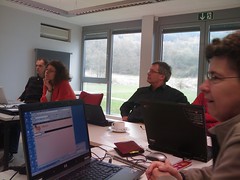
A group of researchers from the CELSTEC research programme on Learning Networks for Professionals recently spent a week in Braunshausen (Germany) to write a practice-oriented book on Learning Networks for professional learning.

Organising such 'writing weeks' at a remote location has become something of a habit at CELSTEC. It allows for a team to get immersed in their work, more than would be possible in our hectic workplace, which is often characterised by important tasks that get higher priority than the writing process.

It was a very fruitful week with interesting discussions about the concepts that we take for granted when we are dealing with external 'clients' for whom we develop concepts and solutions for learning networks. On the final day, I felt it was a pity that we hadn't taken steps to (a) organise short active group reflection sessions - as we had during the Library School week in Umbria - or to (b) actively ask participants to capture some of those interesting discussions using Twitter, blogs. mindmaps or other tools. It seems that - if reflection is not actually built into the programme of my working activities - I hardly ever reflect on my own thinking processes, being caught up in the day-to-day and hour-to-hour thinking and working processes themselves.

Something to remember!
(But even this thought is a déjà-vu ;-)

Tuesday, October 06, 2009

Future of the Open University

(Image borrowed from Simon Buckingham Shum)

By pure coincidence, I stumbled across the recording of Martin Bean's keynote speech at this year's Alt-C conference - which I definitely plan to attend next year. Martin is the new vice-chancellor of the UK Open University.
Apart from his being a very enthousiastic speaker, his message touched on some of the issues that our own university is trying to deal with. For me, the main focus of his speech was on trying to remove the barrier between formal and informal education, but also that universities need to guard their role of providers of affordable education in the knowledge economy.
I wish I had seen his speech before I did this afternoon's interview with the Flemish newspaper "De Morgen" about the use of new technologies in (higher) education, then I could have referred the journalist to his speech, where he says: First you have to get the people in place, then the processes and only at the last stage get the technology in. This is more or less the message I gave the journalist, but Martin Bean's way of putting it was so much more forceful.
In a sense, Martin Bean's speech also struck me as being very parallel to the discussion we're having with the Dutch public libraries, in our efforts to design, develop and implement a Library School which offers both formal, informal and non-formal education, trying to balance between Innovation, Tradition and Context. Public libraries face a similar challenge as educational institutions, since their role in a fast-changing knowledge society is changing drastically, and they have to establish their position in that society on the crossroads between Society, Culture and Technology. Quite an interesting theme, I think.

Monday, December 01, 2008

Community platform @ OU-UK

Tony Hirst wrote a blog post about the British Open University's new initiative to foster a sense of community amongst its stakeholders, an initiative called Platform.
Platform screendump

Platform is a Drupal-based community site that brings together News, Blogs, Forums, Study-related Issues and some more informal stuff like games, competitions, etc. After the info, some comments - off the top of my head:
  • Platform is open for anyone to join - you needn't be a student, staff member or alumnus to register. This is positive, because it allows others to get a bit of a feel for what's going on On-campus.
  • The standard open blogging function in Drupal has been switched off for registered users, thus limiting the interaction possibilities. Users can, however, submit content to the site or participate in forum discussions, but both types of user-content are moderated by site supervisors. This has the effect that the site feels very much like a student bar, where the institution sets the rules and hands out the drinks, and users are only allowed to choose at which table they want to sit..
  • The added value of registering on the site is that you can rate, tag and comment on stuff that appears on the site. These user actions are not pre-moderated (they appear immediately after posting them), but they are probably scanned by the site supervisors anyway. This adds a nice touch, but - to stay within the metaphor.
  • Currently, the link with the institution's virtual learning environment is non-existing, nor is there a clear link to the institutional website. As such, the community site feels a bit like an 'in-between' place to be. And not really integrated to form a 'single user-experience'.
In short, Platform is a promising initiative that is quite relevant in the light of my own work. For instance:
  • In allowing rating, annotation and tagging - RAT, for short - Platform has achieved one of the goals of the OUNL's goals in setting up new user-centered services.We also want to offer rating, annotation and tagging of items. We are not entirely certain of which items we want to open up to user feedback. The OU-UK has chosen to allow feedback on 'safe' items on the platform, and not items on their institutional homepage or in the virtual learning environment.
  • Our ideas of integrating the community aspects of the OUNL in an integrated personal workplace would bring together the formal and informal communication related to the student/stakeholder in one single place. We intend to minimise the barrier between the learning environment and the community environment, which will hopefully enhance the user experience of the OUNL as an integrated campus.
  • Finally, our idea of the personal workplace for all stakeholders starts from the main assumption that the user is in charge, and not the institution. We will be offering different information and interaction services in an integrated environment, but the user will be in control.
It would be interesting to be kept up-to-date on the usage of Platform, the success criteria that the OU has set itself and the future plans. Anybody?

Wednesday, August 27, 2008

Mobile learning - part 1


In the framework of the OUNL project on new educational services, Henry (co-project leader) and I have started to buy some mobile devices to try and experience issues with mobile learning. Within the project we have a track on technology and trend watch, namely. The first device was delivered to us on Monday, the HTC Touch Diamond smart phone, with a Vodafone voice and data price plan, including mobile broadband.

It's a very nice-looking and slick device with quite some functionality (running on Windows Mobile 6.1), but the interface reacts in a very slow way, which often leads to unwanted results.

It took about 3 hours to get started with the device. We have mainly looked at its connectivity.
  • Wifi at the office is problematic. It keeps asking for my credentials, even after I have selected "remember password" innumerable times. Maybe I am too far away from the access point? Henry does not seem to have the problem 4 offices down the hall.
  • Wifi at home is very easy.
  • 3G mobile data was not functioning. Turned out that the Access Point was office.vodafone.nl, instead of the pre-installed live.vodafone.com. Thanks to the ICT support staff for the solution.
  • Active Sync was not as straightforward as indicated in the manual. Already had to un- and re-install the application on my laptop. Now it seems to work again, except for the direct sync with Exchange server at the office. Probably a security issue.
I already installed two applications:
  • Mobipocket reader was a piece of cake, as it started from the laptop version of the application. I did not have to actively download anything, just had to get the HTC to sync with Mobipocket reader, and that took care of the install for me. Neat!
  • Skype for Windows Mobile. I first tried to install from the laptop, but I got the message to shutdown all other apps, which I didn't want to do, so I downloaded the .cab-version and installed it from the device itself. We tested Skype on the HTC, but found the connection quality not very satisfactory. On a wifi connection, there was quite some delay. On the 3G Mobile connection, the sound was distorted and the conversation frequently interrupted.
  • Want to try an app such as FlashMeeting, one of these days.
More updates to follow ...

Tuesday, January 29, 2008

Briefly back to Flanders...

Last week was the start-up of a new project at the Katholieke Hogeschool Limburg - one of my previous employers. The project is called "Open Hogeschool - een antwoord op vraaggestuurd leren van werknemers" and aims at developing blended learning approaches and suitable educational materials for postgraduate education aimed at professionals with a professional bachelor's or master's degree (alumni of so-called hogescholen - polytechnics). The OUNL - represented by Marlies and myself - act as academic coaches to the project. It is a three-year project, driven by the small research group [ed+ict], headed by Valère Awouters.
There are some interesting initiatives being developed in Flanders within the field of digital didactics. The EliseLeren course - which I have co-ordinated for some time - will possibly be continued through a number of new initiatives.
  • DIVA vzw. has founded TOLL-NET, which is specifically targeted at supporting teachers in adult education, and may take over the EliseLeren course for that specific target group.
  • A number of higher education institutions - notably Katho, Universiteit Gent, and PHLimburg - seem to have maintained their interest in continuing EliseLeren for the higher education audiences. We'll be having a meeting on this in the near future.
  • AVNet - KULeuven is investigating the possibility of starting a spin-off course specifically about multimedia and the use of audio/video in education.
Moreover, there are concrete plans for a full-fletched post-graduate course (20 ECTS) on digital didactics, starting in September 2008. I hope to be able to be involved in some of these initiatives, in an advisory function of some kind. Let's see what happens.

Thursday, November 08, 2007

VLE of the future - current status

I want to briefly report on the status of our project on the OUNL's VLE of the future. When the project started in February, the goal was to write an advice for the University Board about the technology needed to support the OUNL's future educational activities. For me - as a newcomer at OUNL - it was not clear what the future educational strategy of the OUNL was, and interviews with stakeholders showed that I was not the only one in that position. I need to add that clear choices were made by the University Board at the end of 2006, but my perception during a round of interviews was that the implications of those choices were not clear to all those involved. The following double choice was made:
  • On the one hand, the main objective remains to offer Dutch-spoken academic courses and bachelor and master degrees for open and distance learning. Target groups here are those that want to combine education and work, or never had the chance to study before. Underlying this is a supply-based business model, centred around high-quality self-study materials with minimal coaching.
  • Next to that, there is growing activity in more targeted areas, where lifelong learners with fragmented learning needs are the target audience. Basic resources for this activity is the existing supply of course materials and of human expertise that can be used in other settings and for other audiences. Also partnerships with other colleges and shorter programmes are offered in this area. The business model for these activities is not quite clear yet - as is the case for most institutions in this rapidly changing area. The student is very much in the centre of this model, and the OUNL wants to be able to offer services and content that provide added value in a way that clients will want to pay for the services.
In order to try and clarify some of the implications of these choices on ICT tooling, the project developed a number of extreme scenario's of the future. These scenario's were not meant as distinct future directions for the institution, but rather as vehicles for bringing across the message that
different business choices imply different business processes (and staff skills) and that different business processes imply different ICT support tools.
I think we may have formulated the message somewhat too pointedly, but as a result I think the message came through.

Next to the scenario's, we formulated a number of basic principles for the future VLE, which we have now given the working title "Personal Learning and Working Environment" (PLWE). These principles are:
  1. Every student his/her own learning environment: personalisation & flexible delivery are important key words. We need to offer an integrated portal entry as well as feeds, widgets and web clients that feed into mash-up tools such as iGoogle, Netvibes or Pageflakes. Moreover, the student is in control of the functionality and tools that (s)he wants to use.
  2. The PLWE needs to support the complete educational process for teachers, tutors and students, and not just the delivery of course materials and interaction (the so-called exploitation processes). The PLWE needs to offer services and functionality for the design, assembly, and delivery of courses / learning materials, for teaching and tutoring, for community building, and finally for the management and maintenance of educational materials and activities.
  3. The student and his/her learning are central to the PLWE, and these need to be supported by the most appropriate digital tools. However, the PLWE needs to be at the same level of priority within the organisation.
  4. Cohesion through architecture: business choices need to be aligned with business processes, with systems and applications, with information and ICT infrastructure. This cohesion needs to take the form of an integrated design that warrants long-term sustainability.
  5. Open standards allow technical components and services to communicate. Moreover, as the OUNL is a small institution, the importance of partnerships and alliances will increase, thus enhancing the importance of (open) standards.
  6. One single infrastructure for all current and future markets and product-market combinations will increase the potential for functional synergies.
  7. Open Source software enhances the extension and adaptation possibilities of the PLWE. Next to that, the OUNL is a public institution mainly funded with public money, and the public can benefit from the software that is developed for the PLWE.
  8. Finally, the PLWE needs to have an experimental setup, next to its production environment to allow faculties and staff to research, develop and test new tools and methods. An easy transition from experimental to production environment is needed.
Next week, OUNL management will discuss these issues and make some decisions about them. More to follow.