Wednesday, November 10, 2010

Open Educational Practices - Expert meeting of OPAL project @ UNESCO - Paris

On Monday and Tuesday, I participated in the "Research workshop on Open Educational Practices" hosted by the OPAL project at UNESCO headquarters in Paris. The workshop was chaired by Ulf Ehlers (University of Essen-Duisburg and project co-ordinator) and Grainne Conole (Professor at Open University). It's been an intensive, but very informative and interesting two days. I got to meet a number of interesting people in our plenary and group discussions, and I bumped into Tom Wambeke, whom I hadn't spoken to in quite some time.
The workshop centered around reviewing, commenting and refining the current OPAL model of Open Educational Practices, and it was organised mainly as small group sessions, in which the participants were asked to answer 5 questions, after which the groups reported. Tim Unwin's brilliant blogpost has mindmaps summarising that discussion, so I'll focus on my own learning points:

For me, some of the more fundamental issues were
  • How do we define Open Educational Practices (OEP)? I felt that there was a consensus amongst the participants that OEP is broader than just practices involving OER, and that it relates to 'openness of teaching practice, learning envronment and educational resources' (Chris Pegler on Twitter).
  • Do we need specific practices for Open Educational Resources (OER), or can we make do with practices regarding 'Educational resources' in general? I share Susan D'Antoni's concern that we must avoid focusing too much on content as the Holy Grail. Let's not replace a 'technology push' within education with a 'content push'.
  • Building on that idea, should we focus on content when we talk about OEP, or should we focus more on learning activities or learning conversations that make use of resources? In that light, I like the CELSTEC view that learning content - artefacts as we label them - are an inherent part of a learning network, but in the sense of social artefacts, not as static, finalised bits of explicit - often factual - knowledge, eg. this working paper by Wigman, Hermans & Verjans (2009).
  • Our discussion group on Monday concluded that "Context, not content is KING", later changed to "Context is QUEEN". The background for stating this so strongly was that it is important to primarily consider the stakeholders' context (national, cultural, educational, etc.) before looking at other aspects of OEP, such as the main dimensions in the OPAL model: strategy, tools, skills.
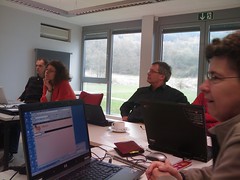
View from UNESCO meeting room

All in all, it has been a fruitful 2-day meeting, supplemented by an active online discussion on Twitter and Cloudworks, which also produced a set of quite interesting and relevant external links and references. My follow-up from this meeting will be to
- continue to act as an external expert
- be a 'national ambassador' for both The Netherlands and Belgium
- to stay active within the wider OPAL community.

Thursday, September 30, 2010

Social media in professional learning: piecing my past and current research interests together

When I was doing my PhD, I often got comments from fellow doctorate students and my supervisors that my scope was too broad. What I did was look at technological (ICT-based) innovation from a personal psychological perspective, as well as from an organisational perspective, thus effectively combining insights and research methods from organisational psychology, organisational theory and management information systems. After I was finished, the jury commented that I had actually written 3 PhD theses, but that's not the point here. The point is that reality is catching up on my research, and that all the pieces of my (personal scientific) puzzle are coming together.
Allow me to expand on this. During the past few weeks, I have been
  • spending quiet some time on laying the groundworks for a chapter on Learning Networks that my department is working on, 
  • rethinking some of the really good discussions at the Alt-C conference about my presentation on "Hybrid professional learning networks", 
  • having internal discussions about learning networks for professionals and with Marc Bijl about Enterprise2.0,
  • following the "Personal Learning Environments Networks and Knowledge" (PLENK2010) course from the side line,
  • participating / contributing to the strategic discussions about the 5-year institutional strategy plan of the Open University in The Netherlands in my role as chairman of the works council,
  • and looking around for job opportunities, as my future prospects here at OUNL are somewhat shady, and I will need to consider where to go next.
All of this has contributed to the insight that the broad range of my scientific efforts so far, is now coming together in the research topic that I am currently dealing with, namely the role of social media in professional learning of individuals and organisations. What I'll need to do is revisit the models and ideas from my PhD and check in how far they can be applied to the topic of social media in professional learning.

    Wednesday, September 08, 2010

    Impressions from my first ALT Conference

    Instead of taking the nap that I should be taking (considering that I have only slept 4 hours for the past 2 nights), I thought I'd write a short blog entry with some impressions of my first ever attendance at an ALT-Conference.

    Lunch with @timbuckteeth @Emmadw and @kathrinder #altc2010 on Twitpic
    Lunch with @kathrinder @timbuckteeth and Emmadw on Day 1 of #ALTC2010
    1. Firstly, I've finally met - in the flesh - some of the tweeps that I feel I've known for ages.
    2. Secondly, I find the Twitter backchannel increasingly important at a conference. For instance, it allowed me to deduce that @daveowhite's talk - that I didn't attend - should have been the opening keynote. I also got to know new tweeps through the backchannel - and made a separate Twitter list for them. It's s become a crucial instrument in my networking at a conference.
    3. The Crowdvine social application that ALT uses for planning the conference and getting to know people is definitely an asset. I found out that some old friends (Sally) and colleagues (Judith) were also attending the conference, and was able to arrange a meet even before getting my hands on the list of attendants.
    4. Oh yes, remind me never to stay at a Hall of Residence again. Cheap, but bleak and depressing and the atmosphere of a prison.
    That's all for now (too tired). I'll report on the things I learned at a later stage.

    Friday, April 16, 2010

    Reflecting when writing a book on learning networks in Braunshausen

    A group of researchers from the CELSTEC research programme on Learning Networks for Professionals recently spent a week in Braunshausen (Germany) to write a practice-oriented book on Learning Networks for professional learning.

    Organising such 'writing weeks' at a remote location has become something of a habit at CELSTEC. It allows for a team to get immersed in their work, more than would be possible in our hectic workplace, which is often characterised by important tasks that get higher priority than the writing process.

    It was a very fruitful week with interesting discussions about the concepts that we take for granted when we are dealing with external 'clients' for whom we develop concepts and solutions for learning networks. On the final day, I felt it was a pity that we hadn't taken steps to (a) organise short active group reflection sessions - as we had during the Library School week in Umbria - or to (b) actively ask participants to capture some of those interesting discussions using Twitter, blogs. mindmaps or other tools. It seems that - if reflection is not actually built into the programme of my working activities - I hardly ever reflect on my own thinking processes, being caught up in the day-to-day and hour-to-hour thinking and working processes themselves.

    Something to remember!
    (But even this thought is a déjà-vu ;-)

    Friday, February 26, 2010

    How to define Networked Learning for Professionals?

    While writing on an article for the Alt-C conference, I stumbled across a problem that I keep having when I start writing, namely the problem of clearly defining and delimiting what it is that I'm dealing with on a day-to-day basis at CELSTEC.
    As member of the research programme on Learning Networks for Professionals, I am researching technologies to support learning networks and trying to apply some of the ideas and concepts - developed within the programme - within internal and external projects. For a recent publication coming out of our research programme, I 'd like to refer to this recent book (Available at Springer - and Google Books).


    Now why do I keep having this problem? It might be because (a) we're dealing with an area that is rapidly developing, and hard to pin down, (b) an area that is on the crossroads between a number of traditional definitions, or (c) my own thoughts are not yet clear enough to explain clearly to my wife or kids what it is that keeps me at the computer for days on end.

    Within the research programme I am not the only one facing this issue of defining and limiting our concepts, as witnessed by the discussions in this Cloudscape. In my search for clear definitions to start the paper with, I came across two interesting online thesauri concerning Learning for Professionals, which I would like to share.
    • The first one is the European Training Thesaurus, developed and maintained by CEDEFOP, the European centre for the development of vocational training. The number of items in this thesaurus is rather limited, and I was unable to find a good match for the work that we're doing.
    • The second one I found rather more useful, the VOCED - Thesaurus. It is part of VOCED, a free research database for technical and vocational education and training, produced in Australia by the NCVER, and supported by UNESCO-UNEVOC.
    Below, I want to just list some of the descriptors from the VOCED Thesaurus that are relevant for my work.
    • Learning: The process of acquiring knowledge attitudes or skills from study, instruction or experience.
    • Education: is mentioned as a related term, but not defined. Interestingly, one can find the following terms among the list of narrower terms. At CELSTEC, we prefer to use the terms Formal learning, Informal Learning, and Nonformal Learning, but VOCED uses the following terms.
      • Formal education: not further defined
      • Informal education: The unorganised process whereby everyone acquires knowledge skills or attitudes through experience and contact with others.
      • Nonformal education: Organised and systematic learning activity often directly associated with work provided outside the formal education system.

    • Lifelong learning: Process of acquiring knowledge or skills throughout life via education, training, work and general life experiences.
    • Continuing education: A comprehensive term referring to all forms and types of education pursued by those who have left formal education at any point and who entered employment and/or assumed adult responsibilities.
      • Continuing professional education: Education of adults in professional fields for occupational updating and improvement; usually consists of short-term intensive specialised learning experiences often categorised by general field of specialisation.
      • Continuing vocational education: not further defined, but is related to Vocational education: Vocational training given in primary or secondary schools or in higher educational institutions designed to develop occupational skills.
      • Continuing vocational training: Further vocational training undertaken by those who have already completed basic or initial training in order to supplement acquired knowledge or skills.

    • Workplace learning: Process of learning through experience at the workplace both formally and informally and through different forms of working arrangements - teams one-to-one. Also the creation of a learning environment in the workplace.
    • Work based learning: Learning that takes place within the work environment using tasks/jobs for instruction and practical purposes. It may be structured as a formal session (see On-the-job training: Training within the enterprise given at the work station and using jobs of commercial value for instruction and practice purposes.) or be an information learning situation. Instructional programs that deliberately use the workplace as a site for student learning. These are formal structured programs organised by instructional staff employers and sometimes other groups to link learning in the workplace to students' formal learning experiences. They have formal instructional plans that directly relate to their career goals.
    • In-service education: Course or program designed to provide employee/staff growth in job related competencies or skills, often sponsored by employers, usually at the professional level.

    • Distance learning: Refers to learning in an environment made possible by the convergence of information and communication network technology where the learner may choose from a greater number of convenient learning opportunities irrespective of geographical location to meet their learning needs at any given time.
    • Distance education: A mode of education in which students enrolled in a course do not attend the institution but study off campus and may submit assignments by mail or email.

    • Learning community: A (geographical) community where individuals work in partnership with education, business and community to address the learning needs of the whole community, using learning as a means towards social cohesion and development, recognising the value of learning for all and supporting lifelong learning.

    • Online learning: Interactive process in which a computer and connection to the Internet are used to present instructional material enable communication between student and coordinator monitor learning and allow individual learner needs to be supported.
    What we are trying to do in projects such as Biebkracht and the Library School, has aspects of all the terms listed above. Our goal is to design, develop and implement a collaborative professional learning network that is a blend of online and offline activities, artefacts (learning resources) and people, similar to the Rob Jacobs' Professional Networked Learning Collaborative.

    Friday, October 09, 2009

    Twitter and the Library School: an anecdote about knowledge management

    I've blogged before about how I think it is very positive that the chairman of my university - Theo Bovens - uses Twitter to inform the world about his daily activities. Yesterday, I experienced just how relevant such small pieces of information can be. Allow me to expand a bit.


    Part 1 - Our chairman is a very active person, who not only chairs the board of the Open University of The Netherlands, but is member of the socio-economic council of The Netherlands, politically active in our region, and member of a number of other boards. In his quest for political backup for Lifelong Learning in The Netherlands, he participates in symposia and conferences, often presenting his arguments in keynotes and contributions. On his Twitter account, he often mentions his schedule for the coming day, and gives short impressions of the new things he has learned during a working day.

    Part 2 - One of the projects that I am currently working on is the foundation of a Dutch Library School, a project in which the Open University and the Association of Public Libraries are co-creating a school that intends to offer library professionals an intensive learning programme on the crossroads of Tradition, Innovation and Culture, with the aim of building the innovation capacity of the whole library sector. Last week, the first group of students and their coaches - including Rob Bruijnzeels, Marlies Bitter and myself - spent an intensive working/walking week in Italy, where we drafted the first design of the Library School. During this week, we discovered that the public library sector and the public educational sector are currently experiencing similar transformations in the knowledge society, and we acquired some new insights.

    Part 3 - Yesterday, Theo twittered about attending a symposium in Maastricht about the future of the public libraries in The Netherlands. This triggered my attention, so I checked out the website of the symposium and found out that Theo would contribute with a presentation about the role of education in the future of the public libraries. After checking with my colleagues, we felt that it was necessary to update Theo on the latest insights from our working week in Italy, so we got in touch with his secretary, wrote a short information update for Theo, and had a very short briefing meeting.

    Now, you may ask: Where is the knowledge management in this?
    • Firstly, although Theo was aware of our Library School project at a management level and had included the project in his presentation, he was not - and could not have been - aware of the new insights that we had picked up in our recent activities. With the multitude of projects that are ongoing within an organisation, the chairperson can not - and should not - be updated on all the current issues and insights. - By the way, I think it is therefore that Theo stopped following me on Twitter: just too much information. You must know the phenomenon.
    • Secondly, our organisation is not so large that it can afford a giant support staff that can do the knowledge work for the chairperson. The weekly board meetings are mainly about making decisions, and not so much about gathering updates on relevant projects.
    • Thirdly, our Intranet is used actively at the Open University, but usually only mentions important milestones, such as new projects starting up, or the intermediary or final results of a project, but never the ongoing issues - again, that would be just too much information. From the information that we distribute, Theo's support staff could not have guessed that there were fresh insights that could have an impact on the Open University's message at this symposium.
    The novelty about Twitter and knowledge management lies in the fact that the responsibility for knowledge management can now be reversed. It is not only the top manager or his support staff that is responsible for gathering information. Every employee needs to actively scan the internal and external environment for information that may have tactical or strategic impact on the organisation, and then take the responsibility to inform the organisation. Because Theo uses Twitter to announce his plans for the day, I was triggered to provide him with up-to-date information, and maybe contribute to the tactical or strategic goals of the university.

    Tuesday, October 06, 2009

    Future of the Open University

    (Image borrowed from Simon Buckingham Shum)

    By pure coincidence, I stumbled across the recording of Martin Bean's keynote speech at this year's Alt-C conference - which I definitely plan to attend next year. Martin is the new vice-chancellor of the UK Open University.
    Apart from his being a very enthousiastic speaker, his message touched on some of the issues that our own university is trying to deal with. For me, the main focus of his speech was on trying to remove the barrier between formal and informal education, but also that universities need to guard their role of providers of affordable education in the knowledge economy.
    I wish I had seen his speech before I did this afternoon's interview with the Flemish newspaper "De Morgen" about the use of new technologies in (higher) education, then I could have referred the journalist to his speech, where he says: First you have to get the people in place, then the processes and only at the last stage get the technology in. This is more or less the message I gave the journalist, but Martin Bean's way of putting it was so much more forceful.
    In a sense, Martin Bean's speech also struck me as being very parallel to the discussion we're having with the Dutch public libraries, in our efforts to design, develop and implement a Library School which offers both formal, informal and non-formal education, trying to balance between Innovation, Tradition and Context. Public libraries face a similar challenge as educational institutions, since their role in a fast-changing knowledge society is changing drastically, and they have to establish their position in that society on the crossroads between Society, Culture and Technology. Quite an interesting theme, I think.

    Wednesday, September 16, 2009

    Connectivism as one learning mode amongst others


    The online course on connectivism and connected knowledge (Edition 2009) started again this week. I participated last year, but mainly as a mega-lurker due to an overload of other projects. This year, I intend to participate more actively, hence this post.
    Last year's short introduction gave me a bit of a feel for connectivism as a learning theory, and it got me thinking. How do learning theories relate to each other? Are they mutually exclusive or rather complementary? Last year, I developed a first thought about this, that goes along these lines (and extends the summary that George Siemens wrote for the course).
    • Learning theories can be argued to be related to different stages in human life, and different learning theories are better suited for explaining learning at different stages / ages of learners. I prefer therefore to call them learning modes, rather than learning models or theories.
      • Behaviorism can be applied to the way very young children learn, when neural connections in the brain are just being formed. Learning takes place in situations like: "When I cry long enough, Mommy feeds me", "When I smile at this nice man, he cuddles me". Stimulus-response based learning can be argued to apply mainly to more basic levels of skills and knowledge that can be subdivided into small chunks in a logical and structured way. As such, the behaviourist approach can be argued to lay the groundworks of knowledge and skills in humans.
      • Cognitivism assumes that knowledge schemas already exist in a human mind, and then focuses on how new information and knowledge is added to the existing (neural) network of knowledge. Focus is on the individual learner, and his or her knowledge creation, storage and retrieval. It can be argued that this learning mode starts at primary school level, when children learn to connect 'loose items' of information into more complex schemas, and begin to see how things are connected. Cognitivism's focus on the individual coincides with the child's attention being focussed on itself and its immediate surroundings, its core family.
      • When children start to become aware of context and social surroundings - often sometime around puberty- it can be argued that constructivism 'kicks in'. The unshakeable thruths that they learned in primary school tend to be no longer unshakeable. Their general knowledge is being remixed and rewritten into a personal and social version of that knowledge. Information is now co-constructed, and no longer taken at face value. The social surroundings play a major role in this phase of life.
      • However, when students leave school / college / university, their existing social network gets distributed, and they need to enter a professional world, where they - more often than not - become (semi-) isolated experts in their field, who are required to put their acquired knowledge to good use, and monetise that knowledge. When they want to keep acquiring and growing their knowledge, they can enter their connectivist mode, and hook up with their extended online social network.
    • The previous is not to say that one learning mode pertains to only one stage in life, but it indicates the dominant learning mode at that stage. There is also a sort of chrono-logical order in the learning modes. Each new learning mode somehow presupposes and builds on the previous mode.
    • I think it's worth to further explore these learning modes and see if they apply to different types of information, skills, knowledge, or competencies. It might well be the case that learning simple and medium-complex skills is best tackled in behaviourist mode, whereas complex mathematical models are best learned in cognitivist mode.
    Well, those are my thoughts for now. Hope that we can further this line of thinking during the CCK09 course.

    Friday, July 24, 2009

    Reflection on a twittering chairperson

    In his most recent (Dutch) blogpost, Theo Bovens - the chairman of the board of the Open University of The Netherlands - notes that he is getting more and more reactions on the fact that he is using Twitter actively. He wonders how he should interpret and use this new channel of communication: "Who needs this, and why?" He is also considering whether he should continue using it. Here's my two-cents worth contribution to his question:

    Theo started using Twitter during his heroic opening of the OUNL's 25th academic year, where he completed a marathon across The Netherlands and Flanders and opened the academic year for 25 people in just 36 hours, but has continued using it since then. During the same marathon, Theo acted as an exemplary mobile citizen by uploading photos and writing blogposts in the car on the road. This feat in itself deserves international attention in my view. This is "Teach as you preach" in its purest form.Now what makes Theo's tweets interesting from my perspective as an employee of the OUNL?
    • Firstly, it is interesting to see the different circles that he moves in, politically, economically and regionally. It provides a degree of insight into the workings of the contexts that surround a small - somewhat rebellious and nontraditional - university. It shows what it takes to keep the mission and goals of our university on the agendas of the decision makers at the different levels of gouvernment and funding in The Netherlands and Flanders. In other words, it augments my understanding of the university, its strategy and tactics and as such his tweets are an important professional asset for me, as I contribute to the digital environment of our organisation, and need to take a wide contextual perspective.
    • Secondly, Theo's tweets also cover his more private interests and activities. Now, you may wonder why this should be important for me as an employee. In my view, these tweets add a degree of 'familiarity', which make Theo into a real person, and not just a hierarchical entity. This insight into his personal life helps build a level of trust that surpasses the brief chance face-to-face encounters in the hallways of the University. This does not, however, deduce from the distance that -in my view- needs to remain between an employer and an employee.

    This brings me to what I see as the added value of microblogging in a professional knowledge-intensive environment, something I have labelled 'virtual familiarity'. Let me illustrate this with an example. I have been following a number of colleagues from the British Open University on Twitter, such as @mweller, @gconole, @sclater and others. I have briefly met Martin (Weller) and Niall (Sclater) on occasion, but I have not yet had the pleasure of meeting Grainne (Conole) in person. Due to the fact that I follow her on Twitter, she has become more than just a colleague who writes good papers and does interesting research; she has become a person whom I have had online communications with (more similar to a real communication than through blogging and commenting), whom I have shared the occasional joke with, etc. When I now meet her at a future conference or workshop, it will be like meeting a close colleague whom I have worked with for years.

    This happened to me in June at the ICDE World Conference in Maastricht, when I met Maarten @maasbrenn, a Norwegian colleague that I had been following for some time. It felt like bumping into an old acquaintance, even though we had not formally met before, and we were able to start sharing insights and opinions about the conference immediately. We started our own little backchannel at the conference, and met for coffees in between sessions, just as I did with my OUNL colleagues, and with a similar degree of familiarity.

    Now, is it important to be 'virtually familiar' with the people in your professional knowledge network? From my personal perspective, it is extremely important, especially in a context characterised by increasing distance. A large group of students at the Open University have problems with the impersonal and distant aspect of distance learning (note that another group actually appreciates those aspects). In my view, microblogging can help make distance education and knowledge sharing/creation more personal and more social.

    Wednesday, June 10, 2009

    ICDE2009 conference, Slideshare and the role of Twitter as backchannel

    Just got back from the ICDE2009 conference, or more precisely the 23rd ICDE World Conference on Open Learning and Distance Education including the 2009 EADTU Annual Conference in Maastricht. The conference organisation left much to be desired (embarassed as I am to have to say so as member of the organising institution), but the content of the conference was overall pretty good. I have twittered during the conference, so you can find my thoughts about the sessions I attended. I also tested Coveritlive.com during one of the plenaries to avoid overloading my followers with tweets they might not be interested in (see previous post).
    As we were about 6-7 twitterers at the conference (which had an attendance of about 600 people) we established an unofficial backchannel through the use of the #icde2009 hashtag. I found the use of the backchannel quite interesting, because it added an aspect of interactivity, which was often lacking during the sessions themselves, especially the plenary sessions.

    I also made a Slideshare Event page for the conference, where I tried to gather all presentations that were available online. I think conference organisers should encourage participants to publish and share their presentations before or during their presentation (Great example set by Terry Anderson).

    Just today @timbuckteeth (Steve Wheeler) pointed out this article on the use of Twitter as a backchannel. I try to embed the article in my blog, so enjoy.

    More than just passing notes in class? The Twitter-enabled backchannel More than just passing notes in class? The Twitter-enabled backchannel Tony Draft study of the Twitter-enabled backchannel at academic conferences.

    Monday, June 08, 2009

    Testing CoverItLive at ICDE2009

    Decided to test run CoverItLive during the ICDE2009 closing plenary session on Day 2.

    Monday, December 01, 2008

    Community platform @ OU-UK

    Tony Hirst wrote a blog post about the British Open University's new initiative to foster a sense of community amongst its stakeholders, an initiative called Platform.
    Platform screendump

    Platform is a Drupal-based community site that brings together News, Blogs, Forums, Study-related Issues and some more informal stuff like games, competitions, etc. After the info, some comments - off the top of my head:
    • Platform is open for anyone to join - you needn't be a student, staff member or alumnus to register. This is positive, because it allows others to get a bit of a feel for what's going on On-campus.
    • The standard open blogging function in Drupal has been switched off for registered users, thus limiting the interaction possibilities. Users can, however, submit content to the site or participate in forum discussions, but both types of user-content are moderated by site supervisors. This has the effect that the site feels very much like a student bar, where the institution sets the rules and hands out the drinks, and users are only allowed to choose at which table they want to sit..
    • The added value of registering on the site is that you can rate, tag and comment on stuff that appears on the site. These user actions are not pre-moderated (they appear immediately after posting them), but they are probably scanned by the site supervisors anyway. This adds a nice touch, but - to stay within the metaphor.
    • Currently, the link with the institution's virtual learning environment is non-existing, nor is there a clear link to the institutional website. As such, the community site feels a bit like an 'in-between' place to be. And not really integrated to form a 'single user-experience'.
    In short, Platform is a promising initiative that is quite relevant in the light of my own work. For instance:
    • In allowing rating, annotation and tagging - RAT, for short - Platform has achieved one of the goals of the OUNL's goals in setting up new user-centered services.We also want to offer rating, annotation and tagging of items. We are not entirely certain of which items we want to open up to user feedback. The OU-UK has chosen to allow feedback on 'safe' items on the platform, and not items on their institutional homepage or in the virtual learning environment.
    • Our ideas of integrating the community aspects of the OUNL in an integrated personal workplace would bring together the formal and informal communication related to the student/stakeholder in one single place. We intend to minimise the barrier between the learning environment and the community environment, which will hopefully enhance the user experience of the OUNL as an integrated campus.
    • Finally, our idea of the personal workplace for all stakeholders starts from the main assumption that the user is in charge, and not the institution. We will be offering different information and interaction services in an integrated environment, but the user will be in control.
    It would be interesting to be kept up-to-date on the usage of Platform, the success criteria that the OU has set itself and the future plans. Anybody?

    Thursday, November 27, 2008

    The Big Ask - Cyberpower for the environment?

    As a dedicated environmentalist, I hope that actions such as The Big Ask (UK - BE) may help to wake (especially our Belgian) politicians up, and get them to act.
    Can you imagine that no politician was willing to participate in a radio debate this morning to answer some of Nic Balthazar's questions, while they spent hours debating the non-endorsement of three French-speaking mayors in Brussels? Setting priorities straight?


    Why does this message appear in a blog about educational technology?
    1. The Obama campaign illustrated the power of viral campaigns on the Web to mobilise voters. I wonder whether education might benefit from this mobilising potential?
    2. Can the use of web technology support more environmentally-friendly education? Is distance education a sustainable alternative?
    3. CELSTEC - my department at the OUNL, formerly known as OTEC - is performing an experiment on distance working. For instance, can the use of technology prevent me from having to drive 130 km every day to work - and still allow me to get the same results in my work?
    But most of all, because I strongly support the initiative, and want to contribute to it through my blog.

    Tuesday, November 25, 2008

    Flock2.0 - A powerful social web browser

    Flock logo
    Thanks to Henry, I got (re-)acquainted with Flock, the social web browser. I installed it yesterday, and played around with it a bit. Here are some thoughts.

    People browser
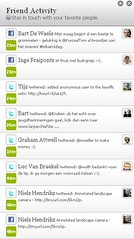
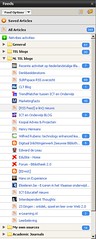
    I linked the "Friend feeds" from my social networks to it (Facebook, Twitter, and MySpace), so now I get automatic updates of all my friends updates'. I am missing LinkedIn, but also the more local networks, such as Netlog or Hyves, and there does not seem to be a way to add people feeds from non-supported services (yet).

    Flock1.jpg

    Media browser
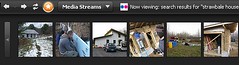
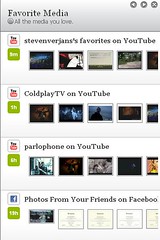
    Next, I added the my Flickr, Picasa and YouTube accounts, and all the media feeds from these sources are centralised in a media bar at the top (or bottom) of the browser. This means any channels you subscribe to, or new additions from your friends. And you can view media either by opening the media bar, or as a widget on your startup screen.


    Feed reader
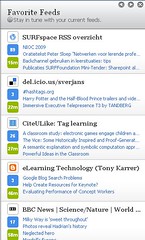
    Next, I exported all my Netvibes feeds to an OPML file, and imported it into Flock. Of course, this is an offline feedreader - as opposed to Netvibes - but it is nice to have all these functions combined in one tool. Moreover, it allows me to read all new feeds in one single page (a feature that Netvibes does not support yet).


    Blog editor
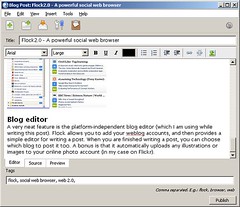
    A very neat feature is the platform-independent blog editor (which I am using while writing this post). Flock allows you to add your weblog accounts, and then provides a simple editor for writing a post. When you are finished writing a post, you can choose which blog to post it to. However, when I tried to actually publish the post, nothing happened.


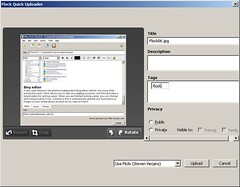
    A bonus is that it automatically uploads any illustrations or images to your online photo account (in my case on Flickr).


    All in all, a very positive experience, if some of the minor flaws are fixed.

    Wednesday, August 27, 2008

    Mobile learning - part 1


    In the framework of the OUNL project on new educational services, Henry (co-project leader) and I have started to buy some mobile devices to try and experience issues with mobile learning. Within the project we have a track on technology and trend watch, namely. The first device was delivered to us on Monday, the HTC Touch Diamond smart phone, with a Vodafone voice and data price plan, including mobile broadband.

    It's a very nice-looking and slick device with quite some functionality (running on Windows Mobile 6.1), but the interface reacts in a very slow way, which often leads to unwanted results.

    It took about 3 hours to get started with the device. We have mainly looked at its connectivity.
    • Wifi at the office is problematic. It keeps asking for my credentials, even after I have selected "remember password" innumerable times. Maybe I am too far away from the access point? Henry does not seem to have the problem 4 offices down the hall.
    • Wifi at home is very easy.
    • 3G mobile data was not functioning. Turned out that the Access Point was office.vodafone.nl, instead of the pre-installed live.vodafone.com. Thanks to the ICT support staff for the solution.
    • Active Sync was not as straightforward as indicated in the manual. Already had to un- and re-install the application on my laptop. Now it seems to work again, except for the direct sync with Exchange server at the office. Probably a security issue.
    I already installed two applications:
    • Mobipocket reader was a piece of cake, as it started from the laptop version of the application. I did not have to actively download anything, just had to get the HTC to sync with Mobipocket reader, and that took care of the install for me. Neat!
    • Skype for Windows Mobile. I first tried to install from the laptop, but I got the message to shutdown all other apps, which I didn't want to do, so I downloaded the .cab-version and installed it from the device itself. We tested Skype on the HTC, but found the connection quality not very satisfactory. On a wifi connection, there was quite some delay. On the 3G Mobile connection, the sound was distorted and the conversation frequently interrupted.
    • Want to try an app such as FlashMeeting, one of these days.
    More updates to follow ...

    Friday, March 14, 2008

    Increasing need for lifelong learning

    My main task - since a couple of months - has been to manage a strategic OUNL project that aims at designing, developing and prototyping technical support services for lifelong learning in the Dutch-speaking market. The OUNL is positioning itself more and more as the Lifelong Learning University of the Netherlands, and a number of initiatives have been started to achieve this aim.
    The main scenario we foresee for the future is that people will want to have support for
    • constantly updating their competences,
    • upgrading their competences (new job demands, new position), or
    • acquiring new competences (different career path, different job).
    Today I stumbled across a European report that gives support for this claim: Cedefop: Future skills need in Europe. The report summary states:

    Between 2006 and 2015, Europe will gain 12.5 million additional jobs at the highest qualification level and 9.5 million at the medium level (especially vocational qualifications). But jobs for workers with low qualifications will decline by 8.5 million. Even jobs for unskilled manual workers are demanding more qualifications, while skilled manual workers will increasingly need medium-level qualifications.

    This has serious implications for employment. A shrinking population implies a continuing need to replace workers, even in declining sectors and occupations. But with skill requirements increasing dramatically, the new workers will need higher qualifications to perform “the same job”.

    A discussion meeting with some external stakeholders from the Limburg region last week supported the case for the OUNL. These organisations are actually "begging" for an independent and reputed institution such as the OUNL to assist them in assessing and developing the competences and qualifications of the regional workforce, especially with regard to workforce mobility.
    There is a clear need in society for a lifelong learning infrastructure, but it seems to me that the initiatives are still rather fragmented, and that educational institutions are trying to pick up the challenge, but are not ready for it yet.

    Tuesday, January 29, 2008

    Briefly back to Flanders...

    Last week was the start-up of a new project at the Katholieke Hogeschool Limburg - one of my previous employers. The project is called "Open Hogeschool - een antwoord op vraaggestuurd leren van werknemers" and aims at developing blended learning approaches and suitable educational materials for postgraduate education aimed at professionals with a professional bachelor's or master's degree (alumni of so-called hogescholen - polytechnics). The OUNL - represented by Marlies and myself - act as academic coaches to the project. It is a three-year project, driven by the small research group [ed+ict], headed by Valère Awouters.
    There are some interesting initiatives being developed in Flanders within the field of digital didactics. The EliseLeren course - which I have co-ordinated for some time - will possibly be continued through a number of new initiatives.
    • DIVA vzw. has founded TOLL-NET, which is specifically targeted at supporting teachers in adult education, and may take over the EliseLeren course for that specific target group.
    • A number of higher education institutions - notably Katho, Universiteit Gent, and PHLimburg - seem to have maintained their interest in continuing EliseLeren for the higher education audiences. We'll be having a meeting on this in the near future.
    • AVNet - KULeuven is investigating the possibility of starting a spin-off course specifically about multimedia and the use of audio/video in education.
    Moreover, there are concrete plans for a full-fletched post-graduate course (20 ECTS) on digital didactics, starting in September 2008. I hope to be able to be involved in some of these initiatives, in an advisory function of some kind. Let's see what happens.

    Monday, December 03, 2007

    Naymz - Spock - and others

    Upon returning from Berlin, I found that I had added quite a few contacts on my LinkedIn list, but also that I had received invitations from some of my contacts for directory and reputation services that I had not previously heard of, such as Naymz or Spock.
    • The former - Naymz - appears to be a tool for creating / managing / updating your online reputation. If you have a large enough network of contacts and recommendations, you can update your status to Premium, and thus get a free top listing on Google searches. I'm not quite sure about this thing, though. It sounds like a modern way of collecting addresses and other marketing information. I did some checking on Technorati and marketingfacts.nl, but found no negative reviews, so why not?
    • The latter - Spock - is not quite as slick as the previous one. It is known as 'yet another search engine', but it does more than that, as Tim O'Reilly notes. It is in fact more of a Web2.0 search engine, than Google is. Thanks to Clo for inviting me.
    The issue becomes more and more: are we not drowning in the amount of social networking tools?

    Friday, November 30, 2007

    Online Educa '07 - Day 2: Parallel session on Systems and Services to Support Today's Students (II)

    After an interesting lunch with Marc Dupuis (Universiteit Leiden), Robert Jan Simons and Keith Russel (Universiteit Utrecht - who blogged about my session), I joint the second session on Systems and services for supporting today's students.

    A first interesting talk by Ahmed Imre Açar (blog) from the Freie Universität Berlin on PLE's and mashups. I have some difficulty in identifying the point he is making. Message: experiment with mashups and webaggregators as a step-up towards the future VLE. Start small, with one or two functions.

    Next was my colleague Eric Kluijfhout, talking about services from an architectural perspective (SOA), not about web services. First, Eric describes the promises of a services approach, where the main drivers for the Dutch HEI are (1) application integration, and (2) reduction of duplicate functional components. My personal position, currently, is that a SOA approach is very promising, but I am afraid that SOA-development is very complex (and some claim that the return of this investment is not straightforward). At the OUNL, there is no clear position in relation to SURF's initiative, yet. Eric concludes with current reality: most Dutch HEI have entered a SOA-awareness phase, early adopters are focusing on the use of SOA for solving operational issues of integrating applications. His final slides were very interesting indeed, as they discussed some of the remaining issues.

    Third was Kristijan Zimmer, University of Zagreb, about complex integrated environment e-Campus (e-bricks and e-mortar): integration of information, learning and collaboration resources. e-bricks deal with the elements of the eCampus, and the e-mortar with the protocols that integrate the e-bricks. Use three LMS's: Moodle, WebCT and a small Croatian system. SMIL for multimedia synchronisation. Kristijan also sketches the issue of isolated information islands, i.e. home-brew systems, developed by staff (specifically problematic at a technical university).

    Final speaker is Nico Juist from Hogeschool INHOLLAND who describes experiences with Sharepoint. They performed a small research project with a focus on the independent student as a knowledge worker (interesting Point-of-View). I am afraid that my after-lunch dip kicked in just then and I got lost in the presentation. (Also an upcoming back-ache). Tea time! Ended with an interesting model (based on Van Weert & Andriessen).

    Online Educa '07 - Day 2: Parallel session on Systems and Services to Support Today's Students (I)

    After the plenary, I had a brief discussion with Wim Westera while we were enjoying tea. Then I went to the Tiergarten room, for the parallel session on Systems and Services to Support Today's Students, in which I was to give the first talk.

    I spoke about "Towards a future VLE for an open and distance learning university". I kept the story rather vague, because there are few concrete results sofar.


    Then Bill Seretta from Learning Networks, LLC told a story of how a small American college moved from a dodgy ICT situation into a situation where there was nearly full wireless coverage, and where a VLE was implemented with FirstClass as one of its components. On the whole, an interesting case study, which showed the importance of top management support for dramatic changes.

    The final speaker was Eric Clarke from the Royal College of Surgeons in Ireland, who presented their Moodle project with great wit and humour. An impressive story which not only highlighted the successes, but also the issues they faced, and the (hidden) costs of their project. Again, top management support was deemed vital for the success of the project. Interestingly, their VLE services not only the Dublin Campus, but also two campusses abroad. I hope that Eric makes his presentation available later.